The Difference Between Ceasing Tax Residency and Financial Emigration
Moving abroad can be an exciting adventure. Between packing up your home and settling into a new country, the last thing on your mind is your tax obligations to the South African Revenue Service (SARS). After all, when you move overseas, don’t your tax responsibilities just disappear?
Unfortunately, this is not the case. Two distinct tax processes should be taken into account when South Africans consider moving abroad: ceasing tax residency and financial emigration. Both terms are similar but have distinct processes and implications.
As SARS intensifies its oversight of expatriate tax compliance, we unpack the key differences between ceasing tax residency and financial emigration, and address the common misconceptions surrounding both processes.
Ceasing Your Tax Residency
Ceasing your tax residency, or tax emigration, is the formal process of notifying SARS that you are no longer a South African tax resident. This process is intended for South Africans who no longer have South Africa as their primary residence, allowing them to formally terminate their tax residency while still retaining assets in the country if they choose to. However, simply living abroad is not sufficient. You must inform SARS that your primary residence is now outside South Africa and that you have not changed your intention of where you see your “real home”, the place where you return from all your wanderings. Once SARS verifies this through either the ordinarily resident test or the physical presence test, you can formally cease your tax residency by obtaining a “Notice of Non-Resident Tax Status” letter.
Financial Emigration
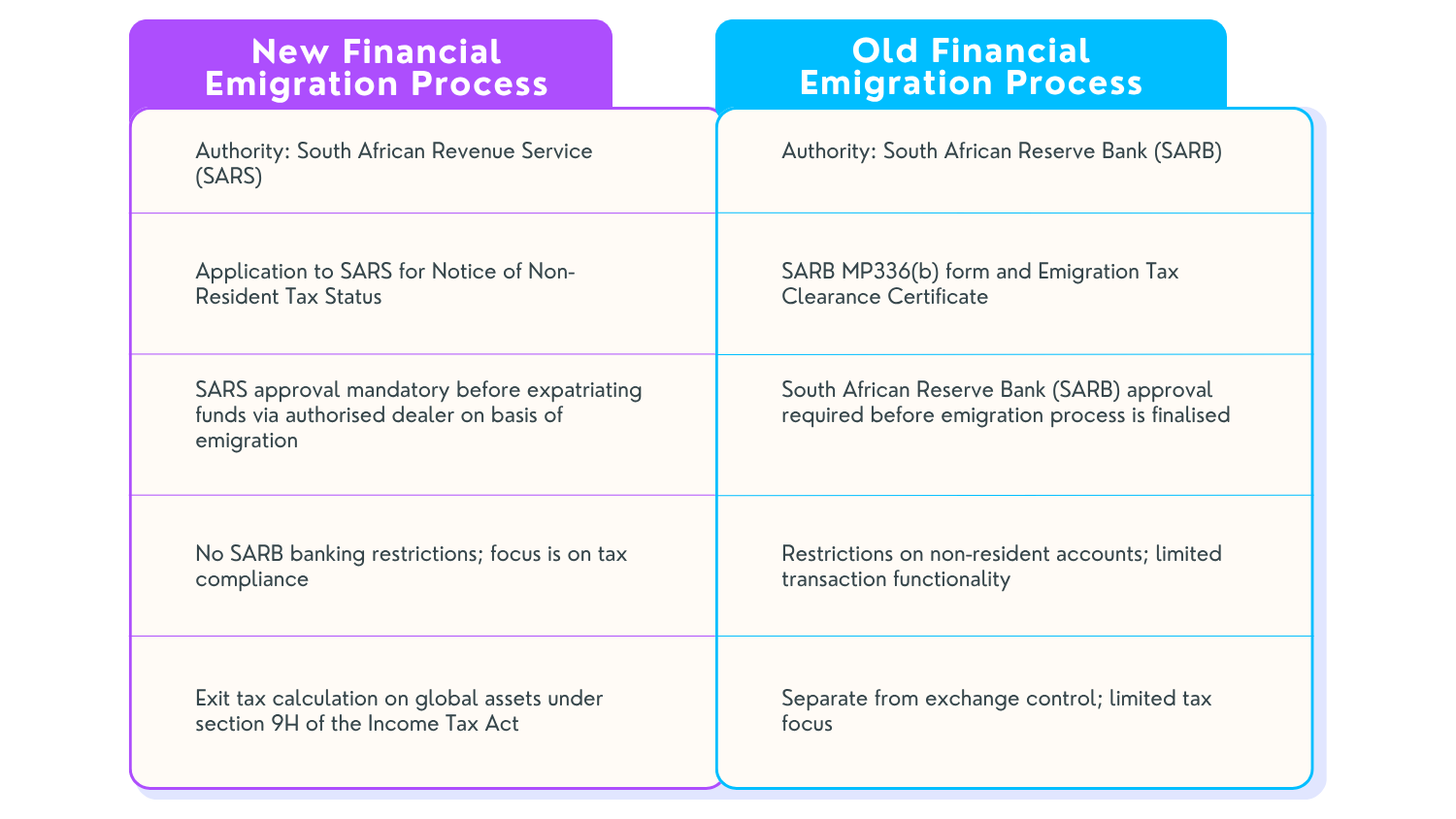
There is a common misconception that financial emigration no longer exists as a formal process. While the process has undergone changes, it has not disappeared. For many expatriates opting for financial emigration, you must cease tax residency before retirement fund. s may be withdrawn after 3 years of non-residency. Financial emigration was previously administered through the South African Reserve Bank (SARB) for exchange control purposes. Since March 2021, financial emigration as a formal SARB process was abolished. Individuals must now cease tax residency with SARS, and retirement annuities can only be withdrawn after maintaining non-resident tax status for three consecutive years. Additionally, you must obtain a “Notice of Non-Resident Tax Status” to finalise the process.
Although SARB is no longer directly involved in approving emigration, financial emigration remains relevant, especially for individuals who wish to access and withdraw South African retirement annuities before the age of 55. Once the process is finalised, certain South African assets can be transferred abroad, including retirement funds that would otherwise remain inaccessible.
After ceasing tax residency, you will generally only be taxed on income sourced in South Africa, rather than on your worldwide income.
Common Misconceptions About Ceasing Your Tax Residency and Financial Emigration
What Really is The Difference Between Ceasing Tax Residency and Financial Emigration?
While the two terms are closely interlinked, ceasing tax residency is the formal tax process, while financial emigration is the broader financial and exchange control implications that follow. You can keep your SA assets under both processes, but financial emigration is a more permanent process as it includes moving assets overseas. In contrast, tax residency allows you to keep your assets, but you are merely deemed to dispose of them for tax purposes.
Is it Still Worth it To Financially Emigrate Right Now?
As previously mentioned, financial emigration has undergone changes in recent years and the process is now handled entirely through SARS rather than SARB. Whether it’s right for you depends on your circumstances. It’s particularly relevant if you want to access South African retirement annuities before age 55, transfer inheritance or future funds abroad, or have no intention of returning to South Africa.
How Long is Financial Emigration Valid For?
There is no expiration date when it comes to financial emigration. It’s a once off declaration that comes with ceasing your tax residency.
Leaving South Africa Automatically Ends Your Tax Obligations
Unfortunately, simply moving abroad does not stop SARS from treating you as a tax resident. You must formally cease tax residency through SARS eFiling, using the RAV01 form before satisfying the ordinarily resident and physical presence tests.
You Can Never Return To South Africa if You’re a Non-Tax Resident
Being a non-tax resident does not prevent you from returning to South Africa. Tax residency only affects how SARS taxes your income, not your right to live in, visit, or work in the country. Many non-tax residents spend their holidays visiting friends and family in South Africa.
Ending Your Tax Residency Forces You To Give Up Your South African Citizenship
Not true! Ending your tax residency does not affect your South African citizenship. You can cease to be a South African tax resident with SARS but still retain all that comes with being a South African citizen, including voting.
Ending Tax Residency is an Expensive Process
While certain tax processes can feel complicated and overwhelming, the process of notifying SARS and obtaining your “Notice of Non-Resident Tax Status” letter is straightforward. Where it can become costly and complicated is gathering the right documents and navigating certain tax implications, such as the deemed disposal of certain worldwide assets (exit tax). However, working with a tax advisor to guide you through the process can greatly reduce stress and make the process much easier to manage.
Financial or Tax Emigration Completely Removes All Tax Obligations
This is a common and potentially costly misconception. Financial emigration or ceasing your tax residency does not completely eliminate all South African tax obligations. It only means that SARS cannot tax you on your worldwide income, but you may still be liable for tax on income sourced in South Africa. If you earn income from South Africa, you are still liable for South African-sourced income tax. These may include income streams such as: rental income, pensions, annuities, and certain investments.
Can You Still Invest in South Africa After Financially Emigrating?
Yes. You can still invest in South Africa even if you are not a South African resident.
Common Mistakes When Emigrating:
If you’re considering emigrating, there are a few considerations you should keep in mind when it comes to your tax status:
Assuming tax residency ends automatically
Not declaring exit tax
Attempting to withdraw retirement funds too early
Not formally updating your SARS status
The Right Path For You
The decision to cease tax residency or pursue financial emigration depends on your long-term intentions, as well as the type of assets and retirement funds you hold. Financial emigration is not necessary for all expatriates, as South Africans may use their annual R1 million Single Discretionary Allowance and R10 million Foreign Investment Allowance (subject to a SARS tax clearance certificate) to transfer funds abroad. These can be used for foreign investment and asset transfer without having to financially emigrate.
There are a number of reasons why many of our clients choose to financially emigrate, including:
Being able to access your South African retirement annuities before the age of 55
Being able to transfer future South African inheritance funds out of the country without being subjected to the SA resident exchange control process.
Additionally, this can be a good option for individuals who have no intention of returning to South Africa and want to formalise their financial position with SARS and the South African Reserve Bank. It’s important to note that until you have formally emigrated, your status will be as a South African tax resident temporarily abroad, and you will not be permitted to withdraw your South African retirement funds out of the country.
The Takeaway
Financial emigration and ceasing your tax residency may seem similar, but they can have different outcomes. Both, however, require careful planning and a solid understanding of the process to ensure a smooth transition and avoid unnecessary tax implications. Eqeight is here to guide you through the process, helping ensure your transition is smooth and your tax obligations are managed correctly.
We’re here to help you every step of the way — chat to us today about which option is best for you.