First Provisional Tax: Common IRP6 Mistakes for Owner-Managed Businesses
August: a month when business owners and accountants find themselves face-to-face with SARS provisional tax payments. In theory, provisional tax seems like a simple system that requires business owners to make just two payments a year. In reality, it’s one of the most misunderstood aspects of the South African tax system, leaving room for mistakes.
To help you navigate this tax season, here are some of the most common mistakes and misunderstandings we spotted in the latest provisional tax filings.
What is a provisional taxpayer?
Provisional taxpayers are generally individuals who are not subject to PAYE deductions. However, here’s where things become a little more nuanced: you can still be a provisional taxpayer while earning a salary that is subject to PAYE if you have other sources of income over and above your salary.
For example, if you earn income from freelancing, self-employment, dividends, interest, rental income or running your own business, and your taxable income is above the applicable tax threshold, you may be required to pay provisional tax. Essentially, provisional tax applies to income on which payroll deductions are not normally deducted and paid over to SARS each month.
For individuals, there are two key thresholds to consider when determining whether you need to pay provisional tax:
Your taxable income exceeds the individual income tax threshold:
Under 65: R95,750 for the 2026 tax year and R99,000 for 2027
65 to 74: R148,217 for 2026 and R153,250 for 2027
75 and older: R165,689 for 2026 and R171,300 for 2027
Your passive taxable income exceeds R30,000:
This includes income such as interest, rental income and dividends.
If either of these applies to you, you may need to register and pay provisional tax.
All companies are provisional taxpayers and are required to make provisional tax payments.
Provisional taxpayers generally receive income on which no income tax has been deducted or withheld. They therefore need to declare this income on their IRP6 provisional tax return and pay the applicable tax to SARS. If you earn a fixed salary with no other income and have PAYE deductions made, you are not required to register as a provisional taxpayer.
How is the first provisional tax payment calculated?
Provisional tax is calculated based on the taxpayer's estimated taxable income for the relevant year of assessment, rather than simply the amount of money the business has earned. This assessment must be supported by available financial information. Additionally, when estimating taxable income for the first provisional tax payment, business owners should consider the income earned to date, their projected income for the remainder of the year and any allowable deductions.
Here’s a brief look at the three provisional tax payments:
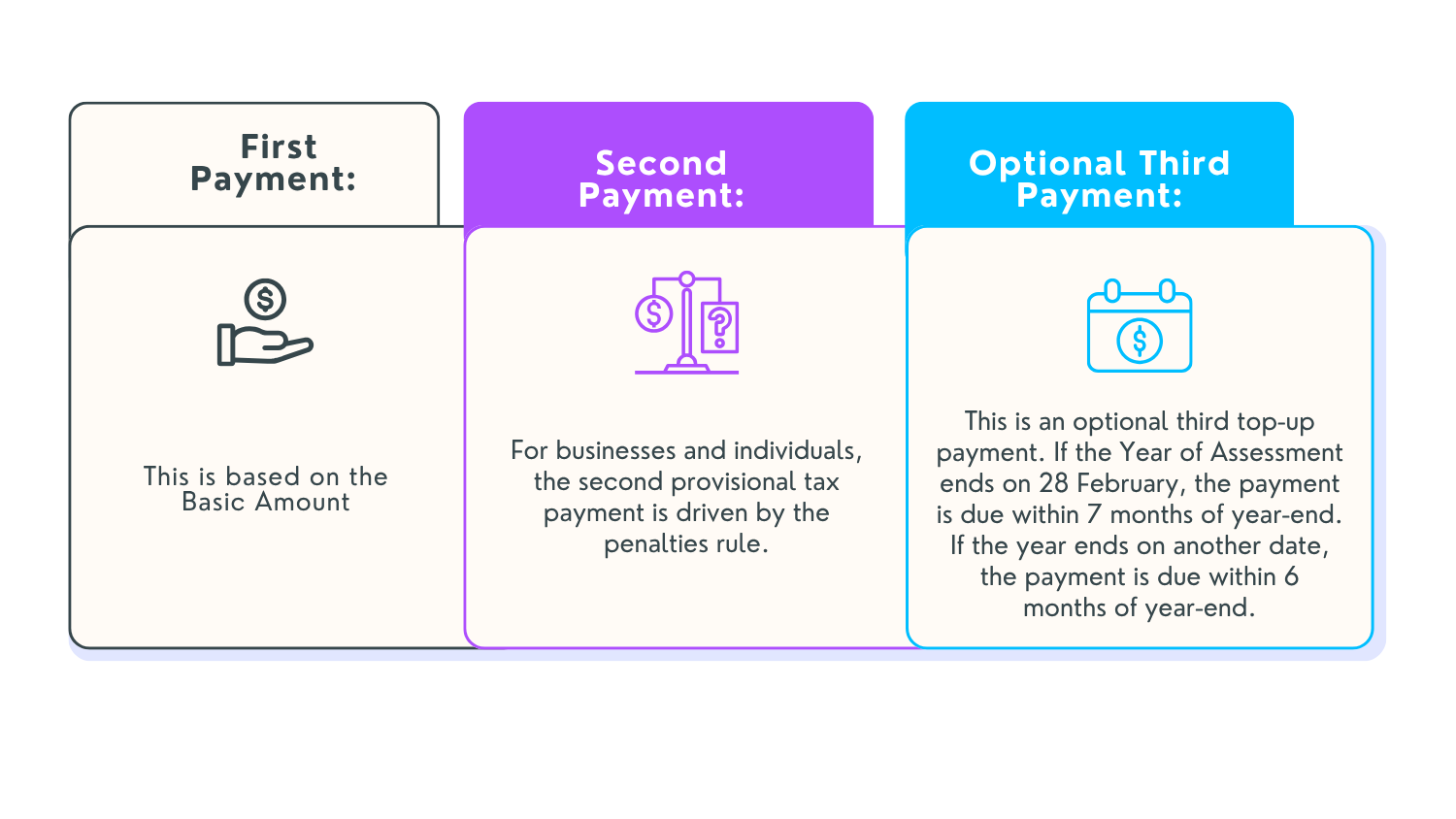
The first provisional tax payment is calculated using the Basic Amount as a starting point. This is based on your previous year’s assessment. You will need to subtract irregular items from that prior year’s income, including capital gains, retirement lump sums, and lump sums from employers.
For example:
Previous year’s taxable income is: R500,000
Taxable capital gain included in that income: R50,000
Subtract the capital gain:
R500,000 – R50,000 = R450,000
Your Basic Amount would therefore be R450 000, before any applicable escalation.
To make things a little more complicated, you will have to keep the 18-month rule in mind.
The 18-month Rule: If the previous tax year used for the basic amount ended more than 18 months before the current provisional submission date, you must add an official inflation adjustment of 8% per year to the amount.
Let’s say this is the case in your situation, you will then be looking at paying:
R450,000 × 8% = R36 000
Therefore,
R450,000 + R36,000 = R486 000
Your escalated Basic Amount would be R486 000
If you do not have a previous year of assessment to base your basic amount on, you will need to make the best estimate of your taxable income.
While provisional tax is designed to make paying tax throughout the year manageable for business owners, it can become confusing and overwhelming. This can lead to mistakes when completing an IRP6, calculating the amount owed to SARS and a handful of other common mistakes.
Here are a few mistakes you should try and avoid as an owner-managed business.
Common Mistakes to Avoid
Thinking provisional tax only applies to large businesses
There’s a common misconception that provisional tax only applies to large businesses, when in reality, SAR’s provisional tax rules apply to all businesses, regardless of size. This is especially important for small business owners, as the assumption might be that because they run a small business, have a small turnover or only have a few employees, provisional tax doesn’t apply.
Confusing turnover with taxable income
A big mistake many business owners make is assuming that provisional tax is calculated on the business’s total turnover.
As previously mentioned, the IRP6 calculation is based on estimated taxable income, so business owners need to consider allowable deductions and expenses when estimating their taxable income.
Giving SARS a lower estimate
Business owners may underestimate their taxable income when calculating their provisional tax payment. While a lower estimate may result in a smaller payment initially, an estimate that is significantly lower than the final taxable income can result in a shortfall. Depending on the circumstances, this may lead to additional tax, interest and underestimation penalties, as well as unexpected cash-flow pressure.
Missing payment deadlines
The first provisional tax payment and IRP6 are due six months into the tax year. For the 2027 year of assessment, covering 1 March 2026 to 28 February 2027, SARS confirms the first IRP6 and applicable payments are due on 31 August 2026. For individuals, the optional third payment is due 7 months after the start of the year of the assessment, while businesses are expected to make this payment 6 months after the year of assessment begins. For many business owners, this is an avoidable mistake that can be rectified by keeping track through a tax calendar. This allows business owners to stay on top of things and prepare ahead of time in order to calculate their estimated taxable income, submit the IRP6 and make the payment before the deadline.
Failing to Separate Business and Personal Expenses
For many owner-managed businesses, the lines can blur between personal and business finances, especially when utilising the same account. This can create problems when attempting to calculate your provisional tax as it may become difficult to determine which expenses relate to business and may qualify as deductions and which are personal expenses.
Thinking You Can Catch Up on Your Second Provisional Tax Payment
The second provisional tax payment is not meant to be a catch-up. Unfortunately, some businesses think they can pay less during the first provisional tax payment and make up the difference when the second payment rolls around. This is poor financial discipline, as it can result in a large cash outflow that may be difficult to make up later.
Forgetting the Tax Impact of Owner Salaries
Many self-managed businesses rely on loan accounts to fund the business. As the business grows and generates profit, the owner may begin taking money out of the business to fund their living expenses. However, the mistake comes when the salaries they are now in a position to take are not deducted from the business profits, but are instead taken from the loan account. This means the business is left with a tax liability on its profits, even though the cash has already left the business’s bank account. Additionally, these loan accounts can also result in interest having to be charged as per SARS anti-avoidance rule, which further increases the taxable income of the business, resulting in larger tax bills.
Expert Tip:
If you have ever filed taxes before and generated your latest IRP6, there is a section called “Last assessed Amount” and “Basic amount.” This can be used as a guideline as SARS has pre-populated and worked out your basic amount for you already. This should form the crux of your decision when determining your first provisional tax payment.
The Takeaway
In order to remain compliant, owner-managed businesses must keep financial records, review income estimates before each provisional tax period, and use SARS eFiling to monitor submissions and payments. Whether you run your own small business or are a freelancer, dealing with provisional tax can be overwhelming. Working with a registered tax professional can help you eliminate stress and keep you compliant throughout the year.
Eqeight works with you to determine whether you need to pay provisional tax, keep you compliant with your tax obligations and ensure your first provisional tax payment is calculated accurately.
Get in touch with us today to remain compliant this tax season.