When Should You Outsource Your Financial Manager?
Many business owners only realise they need a finance manager when cash flow becomes unpredictable, SARS deadlines start piling up, or they are making big decisions from outdated reports. However, by the time these problems arise, it’s usually a symptom of something much deeper: the business has outgrown its basic financial systems without realising it.
As a business scales, finance functions must grow with it, requiring more than just basic transaction record-keeping. Eventually, SMEs will require a finance function that can provide accurate insight, oversight, and strategic planning, which may lead to the need for an outsourced financial manager who can deliver senior financial expertise without the commitment of a full-time hire.
What does a finance manager actually do?
There’s a common misconception that bookkeeping and financial management serve similar functions within a business. Bookkeeping records what has already happened in the business: transactions, payroll, reconciliations, and financial records. Financial management goes further. It helps leadership understand what is happening now, what the numbers are saying, and what decisions need to be made next.
The latter is where financial managers step in. A financial manager bridges the gap between the numbers and strategic decision-making and is considered the architect of an SME’s financial future, as their role is primarily to support the planning and decision-making of a growing business.
Here are just a few skills they possess to ensure a business’s finance function is optimised:
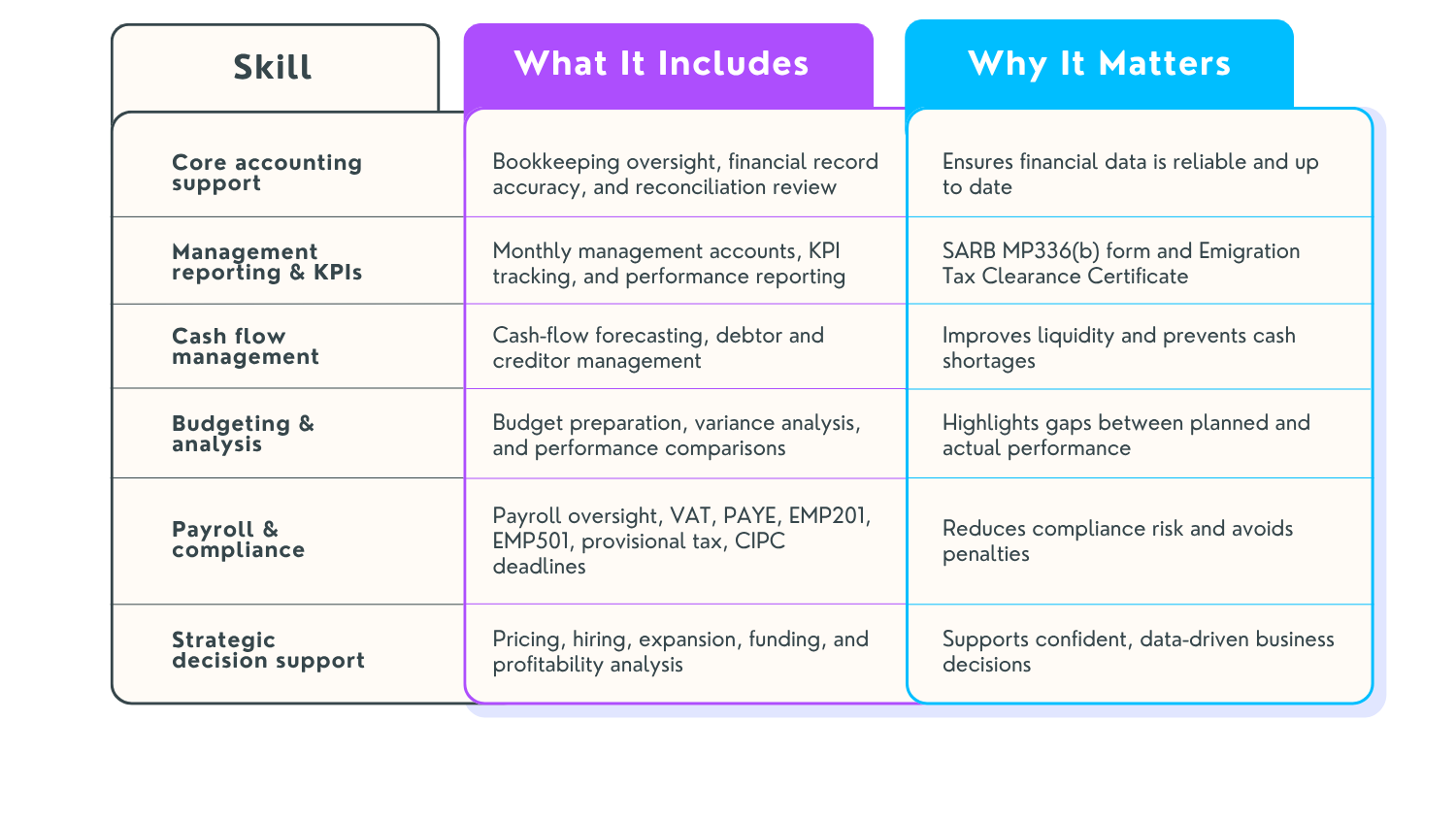
These key functions allow businesses to turn financial information into actionable insights. This means identifying trends, highlighting risks, and uncovering opportunities. Through this, businesses can make informed decisions, assess new opportunities, and evaluate the success of their business strategy, giving them greater clarity and control over profitability and growth.
10 Signs the business is ready to outsource
You only know your profit months after the fact
Even the best business strategies can fail without the right information, and that includes knowing and understanding your profit margins, which help support sustainable growth, control spending, and improve cash flow planning. If you’re only collecting information around profit months later, this can lead to missed opportunities around tax planning, forecasting, and could even lead to costs eating into your margins. Having an experienced finance manager in place can help your business grow with up-to-date information that allows you to respond to challenges and opportunities in a timeous manner.
Cash flow is unpredictable, even when sales look good
Cash flow challenges have the ability to influence the success and future of a business. Unfortunately, even when sales performance is strong, businesses can experience cash flow pressure simply because income is not received on time. This can hinder growth, as SMEs put off investing in upskilling their businesses due to cash-flow pressure.These cash flow problems happen because businesses see the problem after the fact, but through experienced financial management, even when sales remain the same, cash flow can improve.
A finance manager helps address these challenges through cash flow forecasting, debtor and creditor reviews, and better working capital management. In particular, cash flow forecasting is essential to avoiding unexpected cash flow shortages or financial instability. By projecting future cash inflows, outflows, and needs, businesses can make informed decisions about the overall financial health of the business.
As businesses grow, cash flow becomes more complex due to delays in payments, mismatched income and expenses, and limited visibility over working capital. Without regular forecasting and active monitoring, it becomes difficult to understand the true cash position of the business.
You are using personal funds or personal credit to support business expenses
According to a survey conducted by financial institution, Lula, around 59% of SME owners are utilising personal credit to bridge their funding gaps. Unfortunately, poorly managed cash flow leads to cash shortages, which in turn may require taking out personal credit to cover business expenses.
While some degree of personal financing is common when starting a business, relying on it as a long-term strategy is not recommended, as it can restrict growth and expose the business to significant financial risk. Utilising personal finance as an established company may be a symptom of a deeper issue, such as poor cash-flow management, lack of forecasting, weak working capital controls, or not understanding where cash is being consumed. Better financial management allows a business to plan proactively and reduce its reliance on personal finance to sustain day-to-day operations.
VAT, PAYE, EMP201, EMP501, provisional tax, and CIPC deadlines are becoming difficult to manage
As a business grows, so do its financial obligations, and the processes required to manage them often become more complex. This complexity can make it difficult to keep track of VAT submissions, PAYE obligations, EMP201s, EMP501s, provisional tax, annual returns, and CIPC requirements. Unfortunately, missing deadlines doesn’t just create stress, but it can lead to penalties. The general rule of thumb is, if it takes more than 10 – 15 hours per month to complete compliance obligations, or it causes delays, it’s time to look at hiring a finance manager.
Expert Box

Compliance is no longer a box-ticking exercise. Authorities such as SARS, the CIPC, the Department of Labour and the SARB now have access to significantly more data than before, and they are using it.
Audits, verifications and compliance checks have increased as these authorities continue to share, compare and cross-reference information across multiple data sources. The result is a much lower tolerance for inconsistent, incomplete or unreliable submissions.

Businesses are increasingly being scrutinised when it comes to mismatches between statutory returns, third-party data and internal records. For growing SMEs, this creates a real operational challenge. Business owners and entrepreneurs are often expected to keep up with changing compliance requirements without having the tools, systems or financial oversight needed to manage the process properly.
This is where a stronger finance function becomes essential. Accurate records are only the starting point. Businesses also need financial management that supports compliance, identifies risks early, and ensures that the information submitted to regulators is complete, consistent and defensible.
Payroll is growing and needs better controls
As a business grows, payroll becomes more than a monthly payment run. More employees often means more complexity: different salary structures, overtime, leave, bonuses, commissions, deductions, reimbursements, benefits and statutory contributions.
This is also where compliance risk increases. Payroll must be processed accurately, but it must also align with SARS and labour-related obligations, including PAYE, UIF, SDL, EMP201 submissions, employer reconciliations, IRP5/IT3(a) certificates and, where applicable, COIDA-related reporting.
Even small payroll errors can create bigger problems. Incorrect classifications, missed deductions, late submissions or poor record-keeping can lead to penalties, employee dissatisfaction and unnecessary scrutiny from authorities. If payroll is becoming harder to review, reconcile and control internally, it is usually a clear sign that the business has outgrown an informal payroll process and needs stronger financial oversight.
You Need Budgets, Forecasts, or Reports for Stakeholders
Whether you're applying for funding, reporting to directors, or engaging with investors, stakeholders don’t only want to understand how the business has performed, but also where it is heading. Financial managers are adept at developing financial forecasts that help interested parties understand where the direction the business is moving and whether it can support future obligations and growth. Access to real-time data and information helps the business and its investors identify opportunities and manage the growth of the company in a sustainable way.
You are making pricing, hiring, or expansion decisions without reliable numbers
Can we afford another employee? Do we have sufficient cash flow to expand? These are all essential questions that require real-time data and accurate financial forecasting. Hiring employees, increasing product or service prices, expanding into markets, or even investing in equipment all carry financial implications which could cost the business if it’s not backed by reliable financial data. The financial function of your business should be doing more than recording the financial transactions of your business, but it needs to help management understand the implications of their decisions.
Your accounting system is messy, manual, or not giving real-time insights
The importance of real-time, accurate financial data cannot be stressed enough. Growing businesses need this in order to identify opportunities and potential challenges. Unfortunately, many businesses invest in accounting software to improve visibility into their performance, only to find themselves relying heavily on spreadsheets or juggling multiple systems that don't integrate properly. This often leads to duplicated work, inconsistent information, and limited visibility into the financial health of the business. When systems become a barrier rather than a tool, it may be time to consider a finance manager. By reviewing processes, consolidating systems, and translating financial data into meaningful insights, a finance manager helps ensure technology supports better decision-making rather than it being a hindrance.
You need senior finance input, but not yet a full-time finance manager
If current financial functions aren’t supporting a business’s growth ambitions, it’s time to re-evaluate whether additional expertise is required. While a dedicated finance management team can add significant value to a business, many growing businesses may not yet have the budget to justify hiring a full-time finance manager. An outsourced finance manager in South Africa provides access to experienced financial knowledge without the cost of paying a full-time salary. This allows growing businesses to strengthen their finance function while maintaining flexibility.
Your bookkeeper is processing the transactions, but no one is interpreting the numbers
There comes a point where basic bookkeeping is not enough. While bookkeeping is a great way to keep financial records up-to-date, it’s not sufficient enough to support business growth. A major barrier to making informed business decisions arises when financial data exists, but no one is actively interpreting how it influences performance, risk, and opportunities. A business’s finance function is about more than just creating reports, but it’s about interpreting those numbers and ensuring they become actionable steps.
Should you outsource or hire internally?
One of the key decisions growing SMEs eventually face is whether to build an internal finance function or outsource it. While both approaches have its advantages, outsourcing finance and accounting functions can provide access to valuable expertise and experience that supports better decision-making and growth. It also makes more sense when senior-level finance input is required, management reporting, control, and cash-flowing planning, but the company does not have the budget to justify a full-time hire. In contrast, building an internal finance team can be the right step if the business has enough operational complexity, volume, and has the finance-management workload to support a permanent role.
However, many businesses find themselves somewhere in-between. They need the necessary management reporting, financial oversight, and strategic guidance, but don’t necessarily require a full-time employee. An outsourced financial manager in South Africa can be highly beneficial for businesses who find themselves in this in between as it allows them to remain flexible and affordable.
What Should Outsourced Finance Management Include?
A common reason many businesses may opt not to outsource their finance function is because there is a misconception that outsourcing is only virtual. In reality, many accounting firms have tailored their services around in-person interactions and face-to-face support when their clients are in need of it – it is all up to what your business needs. A strong outsourced finance management solution should provide more than compliance support. It should help business owners gain clarity, improve decision-making, and build stronger financial foundations.
This often includes:
Monthly or weekly management accounts
Cash-flow forecast and debtor/creditor review
Budgeting, variance reports, and KPI dashboards
Payroll oversight and compliance timeline
VAT, PAYE, provisional tax, and annual returns calendar
Accounting-system review, controls, and process improvement
Regular management meetings with action points
Building a Finance Function With Eqeight
As your business grows, your finance function must evolve to support the growth of your business. What worked for the business when it was just starting out may no longer provide the necessary information and visibility a business needs to grow sustainably.
If your business has moved beyond basic bookkeeping, Eqeight can help you put the right finance function in place without the commitment of hiring a full-time finance manager.
Speak to us about how we can help your business grow.